
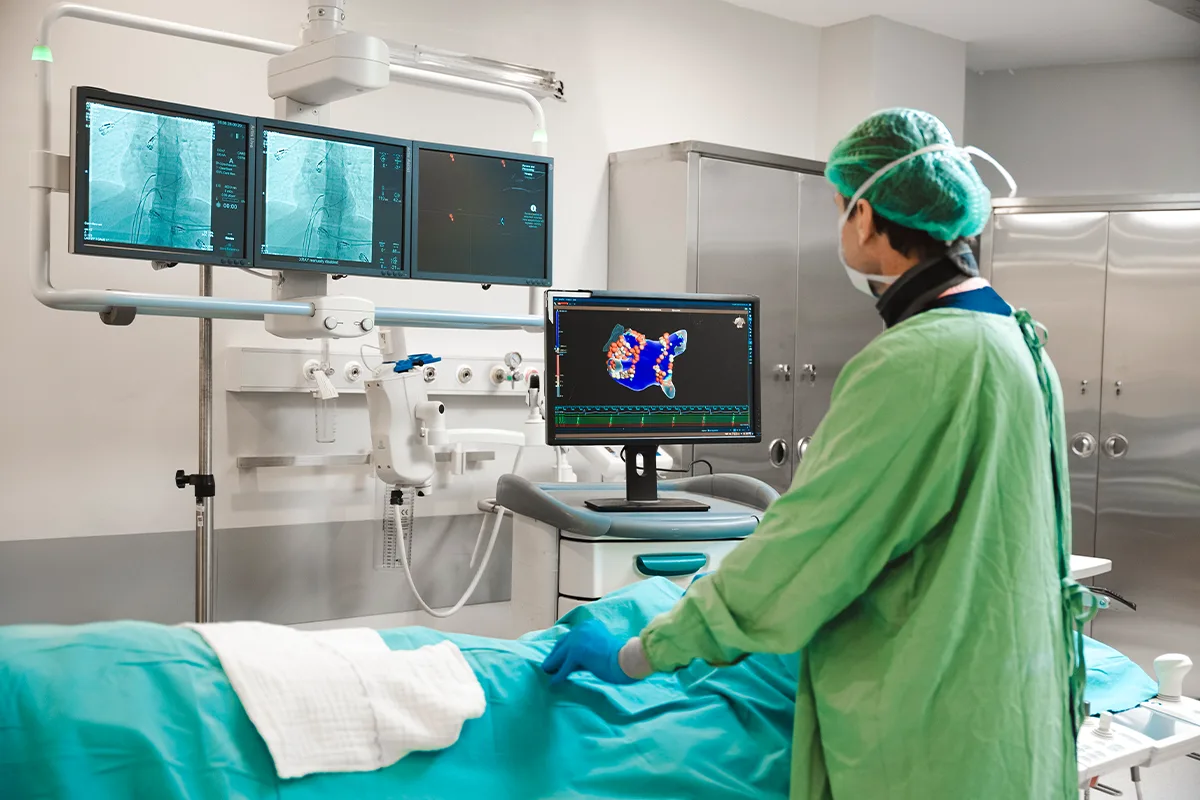
Fractional Flow Reserve (FFR)
Not every narrowing seen on a coronary angiogram needs a stent. FFR shows whether a narrowing is genuinely reducing the blood supply to the heart muscle.
Read more →
Not every narrowing seen on a coronary angiogram needs a stent. FFR shows whether a narrowing is genuinely reducing the blood supply to the heart muscle.
Read more →![[Örnek içerik] [Örnek görsel] IVUS görseli.](https://drumuttandogan.com.tr/storage/media/1200x800/demo-tedavi-ivus.webp)
An angiogram shows the outline of the artery. Intravascular ultrasound (IVUS) shows its true diameter, the make-up of the plaque and the calcium, from the inside.
Read more →![[Örnek içerik] [Örnek görsel] İntrakardiyak Eko görseli.](https://drumuttandogan.com.tr/storage/media/1200x800/demo-tedavi-intrakardiyak-eko.webp)
A catheter with an ultrasound probe at its tip is placed inside the heart. It guides the procedure and lets most of them be done without a general anaesthetic.
Read more →![[Örnek içerik] [Örnek görsel] IVL görseli.](https://drumuttandogan.com.tr/storage/media/1200x800/demo-tedavi-ivl.webp)
Heavy calcification makes it hard for a balloon and a stent to open fully. IVL cracks the hard layers of calcium in the artery wall with controlled shock waves.
Read more →![[Örnek içerik] [Örnek görsel] CTO görseli.](https://drumuttandogan.com.tr/storage/media/1200x800/demo-tedavi-cto.webp)
Coronary arteries that have been completely shut for months or even years can be opened again with specialised wires and microcatheters. The decision rests on how the artery is built.
Read more →![[Örnek içerik] [Örnek görsel] TAVİ görseli.](https://drumuttandogan.com.tr/storage/media/1200x800-top/demo-tedavi-tavi.webp)
Severe narrowing of the aortic valve can be treated with a new valve delivered by catheter, without opening the chest. Who it suits is decided by the heart team.
Read more →![[Örnek içerik] [Örnek görsel] Mitral ve Triküspit TEER görseli.](https://drumuttandogan.com.tr/storage/media/1200x800/demo-tedavi-mitral-ve-trikuspit-teer.webp)
A leak at the mitral or tricuspid valve can be reduced by joining the edges of the leaflets with a catheter. The chest is not opened; the procedure goes in through the vein in the groin.
Read more →![[Örnek içerik] [Örnek görsel] Balon Valvüloplasti görseli.](https://drumuttandogan.com.tr/storage/media/1200x800/demo-tedavi-balon-valvuloplasti.webp)
A narrowed heart valve is widened with a balloon passed up from the groin. On the mitral valve this is the main treatment; on the aortic valve it is usually a step along the way.
Read more →![[Örnek içerik] [Örnek görsel] ASD ve VSD Kapatılması görseli.](https://drumuttandogan.com.tr/storage/media/1200x800/demo-tedavi-asd-vsd-kapatilmasi.webp)
A hole between the atria (ASD) or the ventricles (VSD) can be closed with a double-disc device passed up from the groin. Suitability depends on the type of hole.
Read more →![[Örnek içerik] [Örnek görsel] Üç Boyutlu Haritalama ile Ablasyon görseli.](https://drumuttandogan.com.tr/storage/media/1200x800/demo-tedavi-uc-boyutlu-haritalama-ile-ablasyon.webp)
The source of the rhythm disorder is located to the millimetre on a three-dimensional map of the heart built by computer, and energy is applied to that point.
Read more →![[Örnek içerik] [Örnek görsel] AF Ablasyonu görseli.](https://drumuttandogan.com.tr/storage/media/1200x800/demo-tedavi-af-ablasyonu.webp)
The electrical sources that set off atrial fibrillation are isolated by catheter. It is considered in suitable patients whose palpitations continue despite medication.
Read more →![[Örnek içerik] [Örnek görsel] Kriyoablasyon görseli.](https://drumuttandogan.com.tr/storage/media/1200x800/demo-tedavi-kriyoablasyon.webp)
A balloon catheter seated at the mouth of a pulmonary vein freezes it, creating the line of isolation in one go. It is widely used in atrial fibrillation.
Read more →![[Örnek içerik] [Örnek görsel] PFA görseli.](https://drumuttandogan.com.tr/storage/media/1200x800/demo-tedavi-pfa.webp)
An ablation method that uses very short electrical pulses instead of heat or cold. Its defining feature is that it acts selectively on heart muscle cells.
Read more →![[Örnek içerik] [Örnek görsel] Kablosuz Kalp Pili görseli.](https://drumuttandogan.com.tr/storage/media/1200x800/demo-tedavi-kablosuz-kalp-pili.webp)
A capsule-shaped pacemaker that needs no lead and no pocket under the skin is placed directly inside the heart, through the vein in the groin.
Read more →![[Örnek içerik] [Örnek görsel] CRT görseli.](https://drumuttandogan.com.tr/storage/media/1200x800/demo-tedavi-crt.webp)
Where the ventricles contract out of step in heart failure, a third lead paces the left ventricle as well, so that they contract together.
Read more →![[Örnek içerik] [Örnek görsel] ICD görseli.](https://drumuttandogan.com.tr/storage/media/1200x800/demo-tedavi-icd.webp)
A device that watches for a life-threatening fast rhythm and stops it, first with pacing and, if that is not enough, with a shock. It serves a different purpose from an ordinary pacemaker.
Read more →![[Örnek içerik] [Örnek görsel] Periferik Anjiyoplasti görseli.](https://drumuttandogan.com.tr/storage/media/1200x800/demo-tedavi-periferik-anjiyoplasti.webp)
A narrowing in the leg arteries can be opened with a balloon and a stent, through the groin. Different methods are used above and below the knee.
Read more →